
This is the first article in a series where I take a hard look at responsible gambling rules that sound right in a meeting room but fall apart on the casino floor. I have spent more than 20 years in and around this industry. I am strongly in favour of responsible gambling. That is exactly why I think some of these rules deserve a second look.
Recently I was on a call with C-level executives, discussing responsible gambling guidelines for a country that was about to regulate. This is a normal part of the process. When a country regulates, government and industry stakeholders sit down together and hammer out the framework the new legislation will enact. Some of the talking points are huge, like how tax will be generated and collected. Others are more nuanced.
This article is about one of the nuanced ones: the Autoplay feature. And I believe the industry consensus on it is completely back to front.
Here is the uncomfortable truth about these discussions. The people in the room are usually excellent business people, and very successful. But most of them have a high-level view of the business. Gambling is complex, and the details matter. Without deep, on-the-ground knowledge of how players actually behave, it is easy to reach for the rule that sounds protective rather than the one that is protective.
Because that is what this really comes down to: understanding true player behaviour. Too often, the people making the rules have extremely little experience of actually gambling. And quite often, among those writing the rules for online casinos, most of what gambling experience they do have comes from land-based casinos. Online play is a different world, with different rhythms and different risks, and rules imported from a land-based mindset regularly miss the mark. Ask yourself: how many of the execs in that room have ever spent four hours in a single online gambling session? Because the players they are writing the rules for have. That is something to be considered.
Autoplay is the perfect example.
Let me give the opposing case at full strength, because it deserves it.
In 2021, the UK Gambling Commission banned autoplay for online slots entirely, as part of a wider package that also outlawed spin speeds faster than 2.5 seconds, turbo and slam-stop features, and win celebrations for amounts smaller than the stake. Germany's 2021 gambling treaty did the same, and other regulated markets have followed. In the country whose framework I was discussing, the same position was on the table: autoplay is not conducive to responsible gambling.
The reasoning rests on three claims:
All of this sounds logical at a high level. I want to take each point seriously, because I think each one is either wrong or, worse, backwards.
A properly built autoplay panel lets you set, before a single spin fires:
Here are three real autoplay panels from live slots:


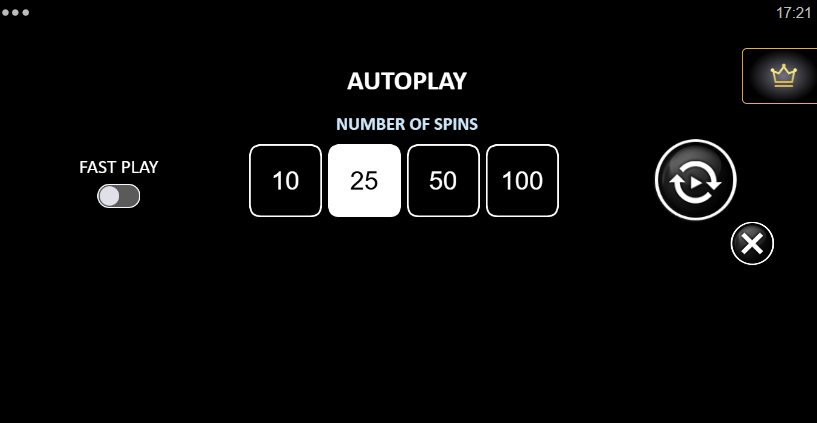
Every one of these lets the player fix the number of spins, and therefore the total stake, before a single reel moves. But look closer, because there is something these three panels have in common: not one of them offers a loss limit or a win limit. Some implementations in the industry do include the full set. These do not. Hold on to that observation, because it is exactly where regulation should have aimed, and we will come back to it.
The full version of this panel is not less control than manual play. It is more. It is every limit a responsible gambling advocate wants a player to set, made in advance, in one place, while the player is calm.
Compare that with the alternative the regulators mandated: a player pressing the spin button hundreds of times, making hundreds of separate in-the-moment decisions, with no structure around any of them.
This is the argument I never hear in the meeting rooms, and it is the one that matters most.
Forcing a player to press every spin does not add control. It adds hundreds of emotional decision points. And the moment those decision points become dangerous is precisely the moment the regulators think friction is protecting the player: a long dry streak with nothing substantial hit.
Anyone who has spent real time around slots players knows what happens next. The frustrated player bumps the bet up to chase the bonus. Then bumps it again. Loss chasing does not need autoplay. It needs exactly what manual play provides: a fresh decision, made in a hot state, every few seconds.

Autoplay, set up properly, is the opposite mechanism. It is one decision, made in a cool state, that the frustrated later version of you cannot casually override mid-streak. Behavioural economists have a name for this: a precommitment device. It is the same principle behind deposit limits, which every regulator on earth endorses. We encourage players to decide their limits in advance everywhere else in the product. Autoplay is the one place where the player does exactly that, and we banned it.
Yes, a determined player can stop the autoplay and raise the stake between batches. But there is a real difference between a limit you must actively dismantle and a limit that never existed. The stopping function is better performed by a loss limit set at the start than by hoping a tilted player makes the cool-headed choice two hundred times in a row.
Autoplay is used almost exclusively on slots. And what do slots players actually play for? Bonus features. Everything in between can be fun, but the real excitement lives inside the bonuses.
Without autoplay, the only route to that bonus is to sit fixed in front of a screen, pressing every spin, for however long it takes. Add mandatory delays between spins and you have engineered a rule whose practical effect is to maximise the hours a player spends staring at a slot machine. Read that again, because it is supposed to be a responsible gambling measure.
Now, I know how the counterargument goes, because the UKGC made it: 34% of autoplay users said they gamble on other things at the same time, and detachment from the session is the harm, not the benefit. Here is my answer. If the player's protection depends on their eyeballs, it has already failed, because eyeballs do not stop a tilted player from betting. Limits do. With a stake cap and a loss limit locked in at the start, the limits are doing the supervising.
This deserves its own section, because it is a huge part of my argument and I have never once heard it raised in a regulatory discussion.
Think about what an autoplay session actually looks like. The player sets the limits, starts the run, and is then able to spend that time making dinner, doing some work, playing with the dog, getting through the chores. In other words, doing activities that are NOT gambling. The session is running, the spend is fixed, and the player's attention, the thing every dissociation researcher is worried about, is somewhere else entirely, on their real life.

Now think about what the manual-only session looks like. Every minute of it is gambling. One hundred percent of the session is the player's eyes on the reels, hands on the button, attention absorbed by the machine. That is the literal definition of the absorbed, fixated play that responsible gambling frameworks exist to prevent. And it is not a side effect of the autoplay ban. It is the mandated outcome. The rule requires that any player who wants a shot at a bonus must give the machine their undivided attention for the entire duration.
So here is the question I would put to any regulator: which player has the healthier gambling/life balance? The one whose pre-limited session runs in the background of an evening spent living their life, or the one required to sit motionless in front of a screen, pressing a button several hundred times? We spend enormous energy in this industry worrying about screen time, immersion and the machine zone. Then we wrote a rule whose only guaranteed effect is to maximise all three.
Chained-to-the-screen sessions are not a safety feature. They are the thing we should be designing against.
This article is predominantly about online casinos, because that is where the autoplay debate is being fought. But since we are talking about the realities only experienced players know, here is one from the land-based world.
The machines at good establishments do get wiped down periodically. Let's face it though: in general, it is a filthy affair. Thousands of hands a day on the same buttons. In the post-Covid world, players notice this in a way they never used to. A machine without autoplay means pressing those buttons constantly, for the entire session, maximising your contact with shared surfaces. Autoplay means a few quick touches to set things up, a wipe of the hands, and the machine does the rest.

A small point? Maybe. But it is exactly the kind of point that never occurs to anyone who has not spent real time on a casino floor, and it is one more example of the gap between how gambling looks from a boardroom and how it actually works in front of the machine.
This is the part that rarely gets mentioned. When the UKGC consulted on the ban, operators made exactly the argument I am making: autoplay is a gambling management tool that lets players fix their spend in advance. The Commission's own research found that 45% of autoplay users said the feature helped them budget. Industry data presented in the consultation showed no correlation between autoplay use and harm, which the Commission set aside on methodological grounds rather than with contrary data.
Even today, the honest academic summary is that high-quality real-world evidence linking autoplay itself to actual harm does not exist. The published research is mostly small self-report surveys. One 2024 study at a live online casino found that offering autoplay likely increased total gambling activity, and that finding deserves respect. But look closely at what was actually measured, because "total gambling activity" means the volume of bets placed, and the number of bets is the one metric autoplay inflates by design.
Of course autoplay users place more spins. That is what the feature does. It does not follow that they spent more time gambling, and it certainly does not follow that they were harmed. Two hundred autoplay spins can run their course while the player is doing something else entirely, with the spend fixed in advance. Two hundred manual spins are two hundred deliberate acts of gambling, each one demanding the player's full attention, each one an opportunity to change the bet. Same spin count, completely different sessions. A raw bet counter cannot tell them apart, which is exactly why bet count is not a metric of problem gambling, and least of all when autoplay is involved. The metrics that actually track harm are money lost against what the player intended to lose, and time spent absorbed in play. On both of those, limit-wrapped autoplay wins.
And crucially, the autoplay tested in that study was the plain version, not the limit-wrapped version I am arguing for. No study anywhere has tested that.
The ban was precaution, not proof. And precaution pointed at the wrong target, because the problem was never the feature. It was the feature shipping without mandatory limits. Scroll back up to those three real autoplay panels: spin counts everywhere, loss limits nowhere. That is the thing regulators should have fixed. Instead they banned the panel and kept the problem.
If I were writing the framework, autoplay would not be banned. It would be regulated properly:
That last point is really the theme of this whole series. The real responsible gambling levers are limits and defaults. Bans on features tend to be what a framework reaches for when nobody in the room knows where the real levers are.
| Well-designed autoplay (with limits) | Manual play only | |
|---|---|---|
| Spend decided in advance | Yes: stake, spins, loss limit locked in upfront | No: every spin is a new decision |
| Protection against loss chasing | Strong: bet size cannot drift mid-run | Weak: bet can be raised on any spin, usually when tilted |
| Loss limit enforcement | Automatic, session stops itself | Depends entirely on player discipline in the moment |
| Screen time required | Low: player is not chained to the device | High: hours of pressing, by design |
| Awareness of each result | Lower | Higher |
| Risk of passive, continuous play | Real, if shipped without limits | Lower |
| Risk of gambling alongside other activities | Real (34% in UKGC research) | Lower |
I have kept the last three rows in because they are the genuine cost of autoplay, and pretending there is no cost is how you end up sounding like a lobbyist. My position is not that autoplay is harmless. It is that limit-wrapped autoplay is safer than the alternative the regulators chose, which is unlimited manual play.
Autoplay, wrapped in mandatory limits, is a precommitment tool: the same mechanism as deposit limits, applied at session level. Banning it did not remove the risk of overspending. It removed the one place in a slot where a player sets every limit in advance, and replaced it with hundreds of in-the-moment decisions and mandatory hours in front of a screen.
That is not responsible gambling. That is responsible-sounding gambling. And the difference between the two is what this series is about.